
Secondary school
General section
Basic elements and key competencies
Chapter two explains the six basic elements of education that are reflected in the work of upper secondary schools. The basic elements should be visible in the learning and teaching of students, the working methods, the organization and development plans of the school, and its relationship with its community. Upper secondary schools must explain in the school curriculum how the basic elements are addressed and assess their visibility and implementation in the school’s internal evaluation.
Key competences are intended to connect the basic elements with the objectives of the students’ competences upon completion of their studies. Key competences relate to the student himself and are thus a student-centred implementation of the emphases of the basic elements. Key competences are used in the planning of study programmes, the preparation of course descriptions, and are also taken into account in assessment and feedback on students.
It is expected that key competencies and core elements will be intertwined and form the backbone of all upper secondary school work, the working environment and school atmosphere, as well as the learning and teaching of all courses. When applying for confirmation of curriculum descriptions, schools are required to explain where and how core elements and key competencies are addressed.
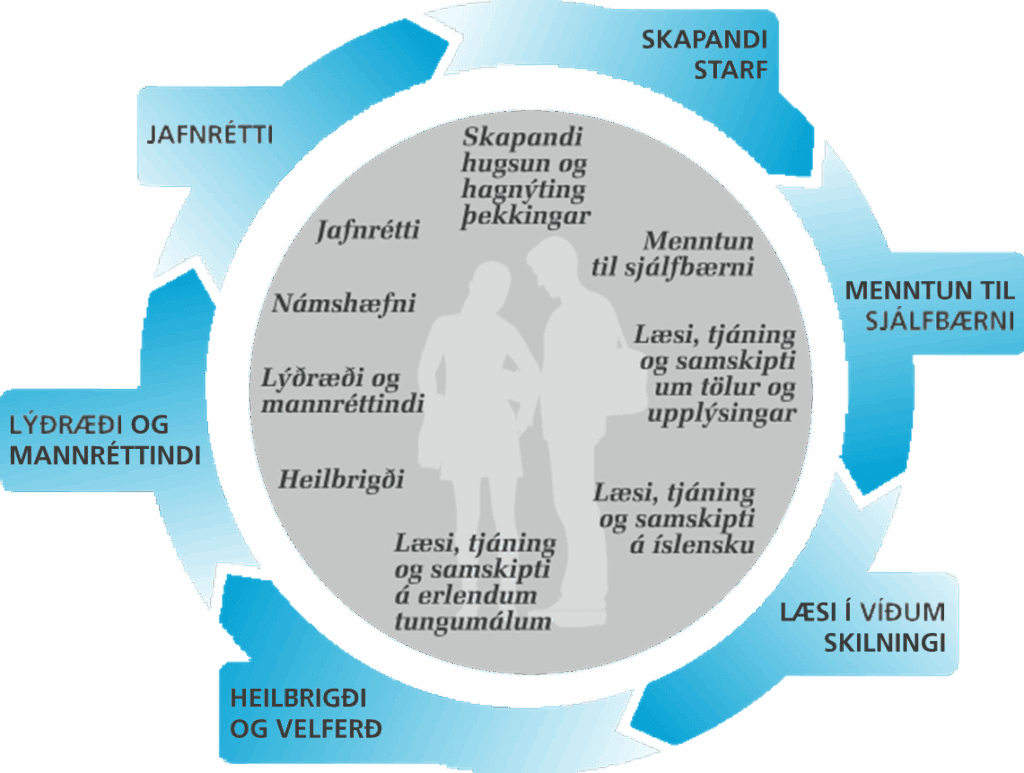
The image on the left is an attempt to show the relationship between basic elements and key competencies.
The basic elements should be reflected in all school activities, while the key competencies link the basic elements to the requirements for student competence.
Key competence
The key competences cover nine areas. Below, each area is described and general examples of criteria are given. The key competences relate to both general and specific competences. Specific examples for health could concern occupational health and safety issues in the field of work that the student is aiming for. Specific examples for human rights and democracy could concern the legal environment and work ethics, and specific examples in education for sustainability could concern a sustainable workplace.
Learning skills
Learning competence involves self-knowledge, i.e. knowing one’s own strengths and weaknesses and being able to make decisions based on them. Learning competence focuses on curiosity, belief in one’s own abilities, and the ability to apply one’s knowledge, skills, and abilities in a variety of subjects in a constructive way. It is also related to the ability to connect knowledge and skills to further study and work.
Key competencies include that a student:
- knows their own strengths and can set realistic goals,
- can share their knowledge with others,
- can use a variety of learning methods and data,
- is independent in working methods,
- can evaluate one’s own work contribution,
- can cope with learning challenges,
- can organize their working time and prioritize tasks,
- can take responsibility for their own learning,
- can use previous experience, knowledge and understanding to solve new problems.
Health
Good health is defined as physical, mental and social health. Every student needs to realize that they are responsible for themselves and their social environment. The responsibility concerns physical health, but to promote good health and general well-being, healthy habits, exercise and a healthy lifestyle need to be cultivated. The responsibility is also related to mental health, for example in terms of a responsible attitude towards bullying and other violence. Social health includes positive and healthy communication and social activity.
Key competencies include that a student:
- is responsible for himself and his own actions,
- takes a responsible stance towards one’s own well-being and health,
- is aware of himself as a sexual being,
- is aware of the value of regular exercise,
- is aware of the importance of a varied and nutritious diet,
- takes a responsible stance against discrimination, bullying and other violence,
- is aware of the harmful effects of smoking and other tobacco use, alcohol consumption and the use of other drugs.
Creative thinking and application of knowledge
Creativity involves shaping and communicating subjects, doing something new or different from what the person knows or has done before. The creative process promotes initiative, reflection and critical thinking and is therefore no less important than the result of the work. A prerequisite for activating and maintaining students’ creativity is that the school creates conditions where initiative, independence and creative thinking are encouraged in as many areas as possible. Innovation and the application of knowledge include an emphasis on creating or creating something new as well as improving what already exists.
Key competencies include that a student:
- shows initiative and creative thinking,
- bears moral responsibility for the creation and application of one’s knowledge,
- can communicate their skills in a creative way,
- can use their creativity in a variety of ways in life and work,
- can enjoy art, culture and creative work in a variety of forms,
- understands how culture and the arts are related to job creation and community development.
Equality
The goal of gender equality education is to create opportunities for everyone to develop on their own terms, cultivate their talents and live a responsible life, while ensuring that everyone is an active participant in creating a society of equality, equality and justice. Gender equality education addresses how age, place of residence, disability, gender, sexual orientation, race, religion, language, ethnicity and nationality can create discrimination or privilege in people’s lives. When preparing for future careers, it is important to open our eyes to the gender-division of the labour market and to promote a less gender-based educational choice than has been the case so far. It is important that the subjects that students deal with are not gender-biased but are based on equality and equality.
Key competencies include that a student:
- respects equality in relationships,
- is aware of one’s own sexuality and sexual health,
- understands how, for example, age, residence, disability, gender, sexual orientation, skin color, beliefs, culture, class, religion, language, ancestry and nationality can create discrimination or privilege in people’s lives,
- is aware of and critical of the influence of role models and stereotypes on one’s own image and lifestyle,
- understands the role of gender and gender structure in society.
Democracy and human rights
The prerequisite for democracy is the shared responsibility, awareness and activity of citizens, which enables them to participate in shaping their society and have an impact near and far. Attitudes, values and ethics are rich elements in democratic education. An active citizen possesses an awareness of personal responsibility, democracy, critical thinking, tolerance, equality, human rights and respects the opinions and values of others.
Key competencies include that a student:
- respects the opinions and values of others,
- respects human rights and human values,
- can express their own opinions and participate in debates,
- takes a critical stance on ethical issues,
- respects the basic principles of society,
- is an active and responsible participant in a democratic society,
- is aware of the value of good behavior and conduct in interactions with other people, animals and the environment,
- possesses positive and constructive social and communication skills.
Education for sustainability
Sustainability is about the environment, responsibility, respect and democratic practices and justice in the present and future. Sustainability education aims to enable people to deal with issues related to the interaction of the environment, social factors and the economy in the development of society. Sustainability education emphasizes understanding the limitations that the Earth’s ecosystem places on humans, equity within and between generations, the rational use of resources and their fair distribution. A prerequisite for a sustainable society is active citizens who are aware of their values, attitudes and feelings towards these factors.
Key competencies include that a student:
- is aware of the various natural resources and can take a position on their rational use,
- knows, understands and respects their environment and nature,
- understands how the Earth’s ecosystem places limitations on humans,
- understands how one’s own ecological footprint and the ecological footprint of communities and nations can contribute to sustainable development,
- can critically assess the value of information about the environment and nature,
- is an active and responsible citizen in his environment and nature,
- is able to take a critical stance towards the environment, society, culture and economic system,
- understands the shared responsibility of the world’s people for the planet and its inhabitants.
Literacy, expression and communication in Icelandic
Literacy refers to the ability of each individual to perceive and understand their environment and society critically and to participate in shaping it. Literacy, expression and communication in Icelandic facilitates active communication in the social, cultural and technological contexts of Iceland. Reading is the most powerful tool for students to acquire knowledge, and expression in speech and writing is a prerequisite for participation in a democratic society. The Icelandic language and culture connect the nation’s past and present.
Key competencies include that a student:
- can express their thoughts, feelings and opinions both orally and in writing,
- participates in conversations,
- uses nuanced language and a diverse vocabulary in speech and writing,
- presents his case clearly and audibly,
- reads a variety of texts for information and enjoyment,
- explains and argues clearly in speech and writing.
Literacy, expression and communication in foreign languages
Literacy in the culture of other nations, expression and communication in foreign languages lays the foundation for understanding, openness and respect. Language skills are the key to information and provide access to professional content in foreign languages. They are one of the prerequisites for being able to have successful communication and cooperation with individuals of other nationalities.
Key competencies include that a student:
- can express themselves in an understandable way,
- listens and understands spoken language,
- participates in conversations,
- uses a diverse vocabulary,
- reads for information and pleasure,
- is aware of the culture and customs that characterize the regions where the language is spoken,
- can relate different attitudes and values that shape the culture in the countries where the language is used, to their own society and culture.
Literacy, expression and communication about numbers and information
Good numeracy is important for everyone to cope with everyday life and work. Numeracy involves the ability to read, express oneself about and make use of numerical information. Information literacy includes, among other things, information technology, where it is important that everyone can obtain data, classify, process, use and communicate information in a critical and creative way. Media literacy enables students to analyze information from different media so that they can critically evaluate it themselves.
Key competencies include that a student:
- can use a variety of technologies in the search for knowledge,
- can express themselves about and use numbers and information in their education and culture,
- can collect data, classify and use information critically,
- can use information technology in knowledge search and knowledge sharing in a critical and creative way,
- can communicate information in a creative way,
- is open to information from different media.